Vatican City
The Vatican City is the center of the Roman Catholic world and home of the Pope.
The visible sign is the St. Peter’s Basilica, dedicated to the Apostle Peter, who is presumably buried here.

The baroque church impress by its dimensions and the huge dome. St. Peter’s Basilica is one of the largest churches in the world. The dome is the world’s tallest dome, made of brick. Every day, about 20,000 people go to St. Peter’s Basilica.
During this visit, we didn’t go inside, because the queue was endless. Nevertheless, we have some pictures of the interior, which were taken in 1980.


Castel Sant’Angelo
The Castel Sant’Angelo was built as a mausoleum for the Roman emperor Hadrian.
Another 6 emperors were then also buried here. The design resembles the mausoleum of the emperor Augustus which we will see later. The style dates back to the Etruscan designs.

Later, the angel castle was rebuilt as a citadel and integrated into the city wall. After that, it served as a base for the Goth king Totila and as living space and fortress for some popes.
Before it found its current use as a museum, it served as a prison. Pope Nicholas II. connected the apostolic palace with the angel castle in the Vatican by a 800 m long underground escape route.
Court of Cassation

The Court of Cassation is the highest court of appeal in Italy. We pass its seat in the Palazzo di Giustizia while we are walk along the Tiber.
Altar of Augustan Peace and Mausoleum of Augustus
We walk further along the Tiber River and reach the modern museum with the altar of Augustan Peace. It was donated to Augustus by the senate and excavated on behalf of Mussolini.
Today, it is exhibited in the newly-built and controversial discussed Museo dell ‘Ara Pacis, built by the architectural firm of Richard Meier & Partners.

On the opposite side there is the church of Saint Rocco and next to it the Mausoleum of Augustus. It recalls in its design to the Castel Sant’Angelo.
It is not open at the moment. A protective building or a restoration and a remake are discussed intensely.

Spanish Steps
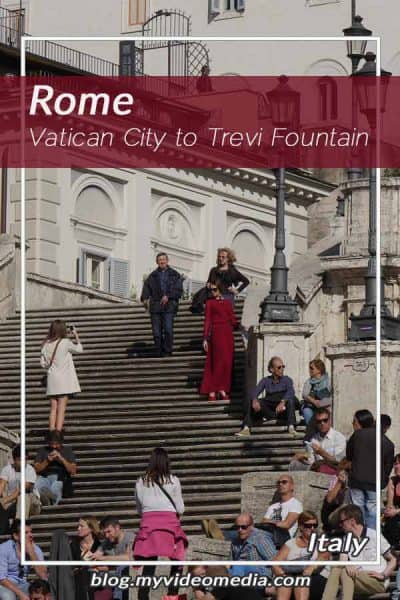
Via the Via del Corso and Via Vittoria we arrive at the Spanish Square and the Spanish Steps. The square owes his name to the Palazzo di Spagna which once housed the Spanish Embassy and was extraterritorial possession of Spain.
The church of Trinità dei Monti was financed by the French State. The Spanish Steps was co-financed with funds from the French Ambassador. France considered itself at that time a protecting power of the pope .

At our visit, the church Trinità dei Monti was scaffolded and a gigantic advertisement of H&M. The Roman state must economize and therefore private sponsors stand in and fund the restorations. In return, they may advertise with it.
The Spanish Steps is a popular spot for tourists, so we are not surprised to find an incredible amount of people here
The area around and below the Spanish square of Via Condotti was formerly an artists’ quarter and is now an exclusive shopping area with designer shops. As a rule, no price tag is in the shop windows.
Piazza di San Lorenzo
To reach the Piazza di San Lorenzo, we prefer to take the via Frattina. Here, the bombings of Rome started in the 2nd World War because the Allies suspected the Germans here.
However, after intervention of pope Pius XII. and from the German side, Rome was declared an open city. The German troops left the town and Rome was spared further destructions.
Please watch the 4k UltraHD video
You are currently viewing a placeholder content from YouTube. To access the actual content, click the button below. Please note that doing so will share data with third-party providers.
Trevi Fountain
A quick look into the Galleria Alberto Sordi convinces us from the image of Rome as a shopping destination.
We then stand disappointed in front of the Fontana di Trevi because this also hides almost completely behind a scaffolding.

We must be content with pictures again from the year 1980.


Nevertheless, we go back to our hotel, with many new and positive impressions!
We cordially thank the group EtruSKA Jazz for the permission to use their music.
Please read on > Walking from Nuovo Mercato Esquilino to Colosseum
Pin it for later
Text, photos and video: Copyright © myVideoMedia