On the way from the Tallin seaplane harbor back to the old town, a huge building complex in a rather desolate condition catches our eye. It is Patarei. We decide to take a closer look.
Patarei
In 1828, Nikolai I. ordered to build the fortress Patarei. As a rule, it housed 2000 soldiers. With the independence of Estonia 1918, Pararei became the central city prison of Tallinn. Later, the Nazis used Patarei as a working and concentration camp.
In 1943, they shot 200 Estonian Jews in the court. In 1945, the site became a Soviet military prison. As of 1991, it was again an Estonian state prison before it was finally closed in 2002.

Already under the Nazis, up to 4500 prisoners were corralled here. Under the Soviets, there were up to 5000. The cells were designed for 6 to 8 prisoners, but in some cases, up to 20 prisoners shared in one cell.
During the Olympic summer Games 1980, Patarei experienced the most macabre chapter. The Olympic sailing competitions took place in the bay in front of the prison.
The windows were bricked up to or locked with steel plates to the sea so that the prisoners could not communicate with the athletes in any form. After the Olympic Games, one didn’t take away the shields. Since that time the prisoners in these cells spent the time in darkness.
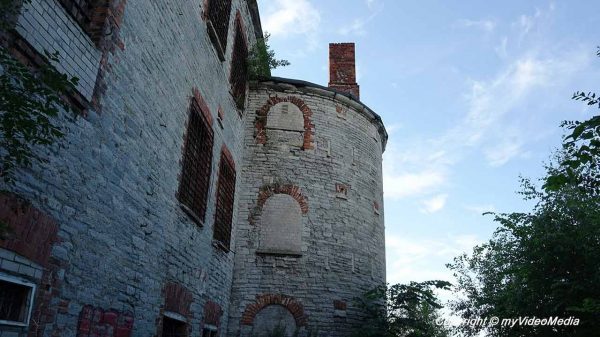
The building piqued our curiosity and we want to visit “the museum”. After paying a small entrance fee, you can move freely in and around the building. We notice a door to the right of the entrance, where some visitors come out. so we decided to start our tour there.
Through a narrow corridor with ventilating or heating pipes, we reach a small room with a pit in the middle. It was the execution room where prisoners were hanged. It’s a gruesome feeling, when we think, that this room was the last sight on this planet for some prisoners.
While the Soviets reigned here, the prisoners spent only the first weeks or months of their captivity here, before disappeared in Siberian Gulags.
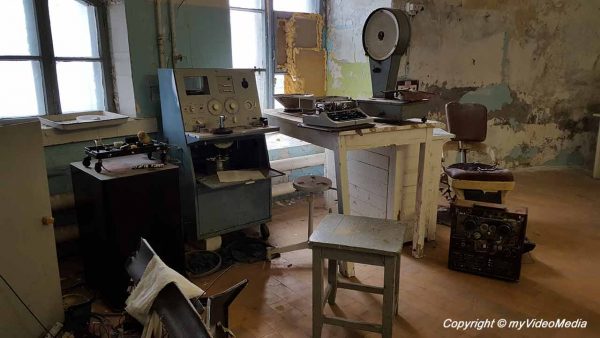
We go quickly into the main wing. Everything looks like one had left the building almost hasty. Nothing is restored, but everything is exposed to weathering. Even so, the rooms are still very alive.
Especially the hospital. Equipment, furniture, and lists stand and lie around as they were left by the employees.

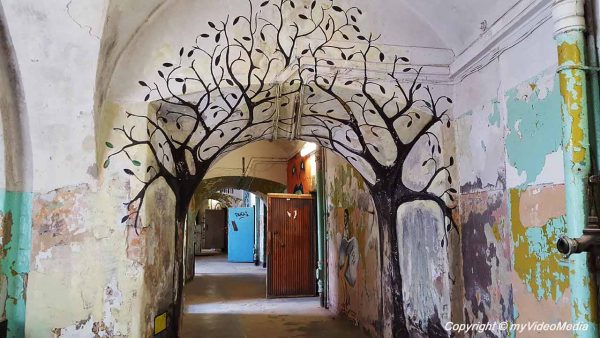
Only on the upper floors, some artists painted graffiti and other art works on the walls, with permission of the owners.
It is interesting to see that even the American presidential election campaign found entry into the graffiti.
In the courtyard are cage-like crates. They allowed the prisoners to breathe fresh air once a week.
With oppressive feelings we leave this place again which has touched us deeply. One feels the feeling of the agony of the prisoners themselves.

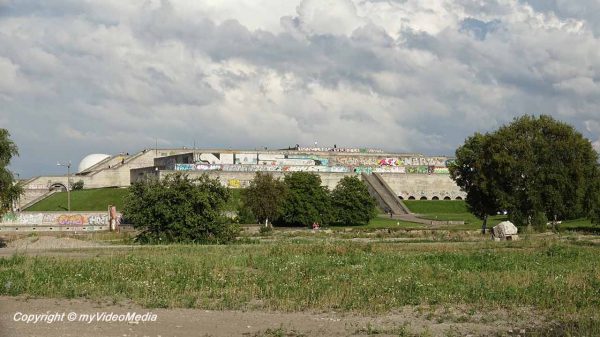
After a short stay at the beach bar, we walk past the Linnahall back to the old town.
Walls of Tallinn
At the cannon tower, called Fat Margaret, we reach the city walls. The tower houses the headquarters of the Estonian Maritime Museum, its branch is in the seaplane harbor. On the roof of the tower is a Café with a terrace. From there you have a nice view of the old town.
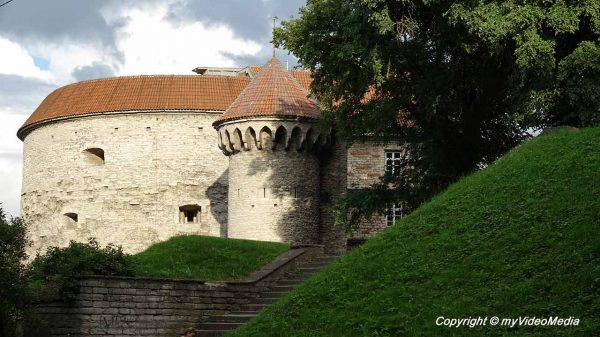
In 1265, the Danish Queen Margaret gave the order to build the fortifications. The development of the 2.35 km long city wall lasted over 300 years. It was up to 16 m high and up to three meters thick and had 40 towers, some speak about 60 towers.
Please watch the 4K UHD video
You are currently viewing a placeholder content from YouTube. To access the actual content, click the button below. Please note that doing so will share data with third-party providers.
More InformationReval, as Tallin was called at that time, was one of the best-fortified towns in the Baltic Sea. There were conflicts between Denmark and the German Hanse, respectively the Teutonic Order, which was a member of the Hanseatic League.
Although the open structure of the Hanse is often praised, the lack of a clear structure has led to a lack of innovation and reform. The neglect of new competitors also led to the Hanseatic League sinking into insignificance at the end of the 17th century.
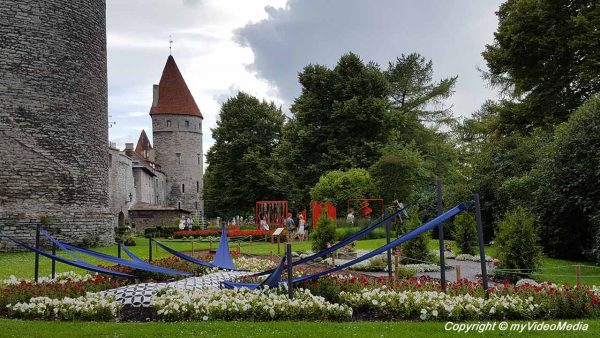
After a short detour into the Toompark, we return via Laboratooriumi and Kooli street.
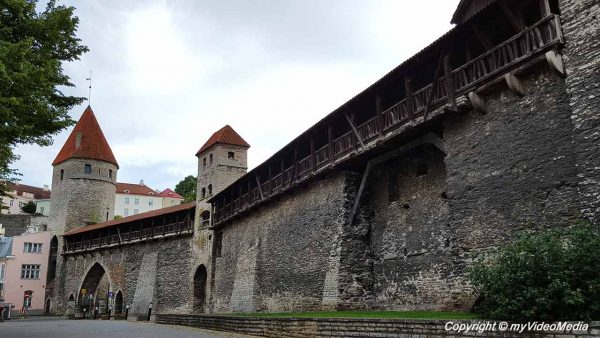
Please read on > Old Town of Tallinn and Kadriorg Palace
Pin it for later

Text, photos and video: Copyright © myVideoMedia